
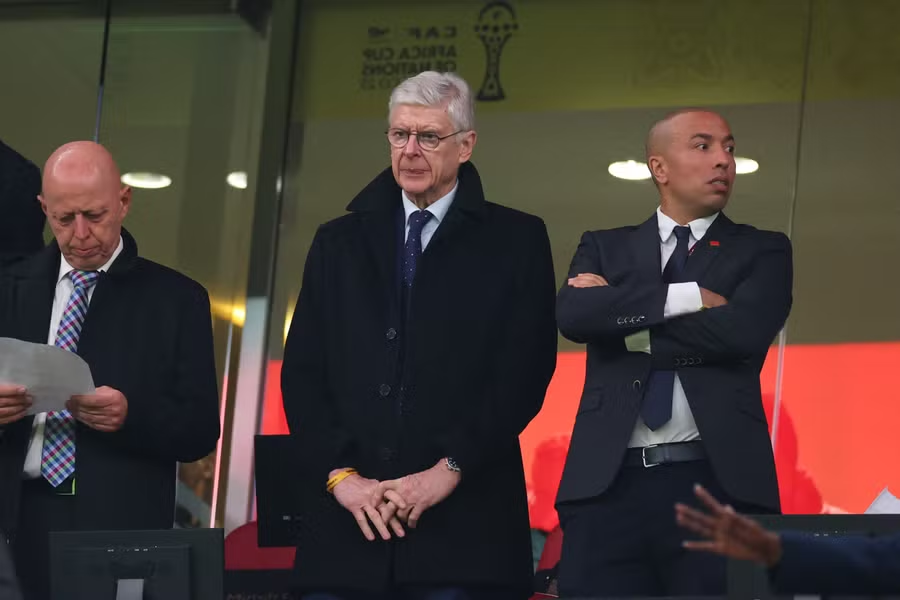
Despite a controversial finale, the 2025 Africa Cup of Nations served as another marker of how far African football has come, both on and off the pitch.
Senegal edged Morocco in a heated final in Rabat on January 18, a match that sparked debate long after the final whistle. Still, once emotions cooled, the wider picture became clear: African football continues to move forward at pace.
FIFA’s Chief of Global Football Development, Arsène Wenger, was present throughout the tournament in Morocco and offered a measured assessment of what he saw. After 22 years at Arsenal and a career that shaped modern coaching standards, Wenger’s observations carry authority.
Speaking ahead of the final, the Frenchman highlighted the intensity and competitiveness of the tournament, pointing to clear signs of progress.
“I would say the competition was extremely intense, which reflects modern football,” Wenger said. “The mental strength of the teams was very high, and physically the level was exceptional.
“It was difficult to predict results because the margins between teams were very small. In the end, the finalists had a little extra in terms of technical quality and maturity.”
That “maturity,” Wenger explained, extends beyond players to the tactical organisation of teams. He was particularly encouraged by the growing influence of African coaches, with all four semi-finalists led by managers from the continent.
Recent history backs that up. The last four AFCON titles have all been won by African coaches: Djamel Belmadi with Algeria in 2019, Aliou Cissé with Senegal in 2021, Emerse Faé guiding Ivory Coast in 2023, and Pape Thiaw leading Senegal again in 2025. Looking further back, only two non-African coaches, Hervé Renard and Hugo Broos, have lifted the trophy across the last 11 editions.
“I was very impressed by the level of coaching,” Wenger added. “Seeing African coaches leading African national teams is extremely positive. The organisational standard was high, and in-game decisions were very strong. That’s very encouraging.
“There is no longer a real gap. In modern football, information spreads quickly and everyone is operating at a very high level, where the differences are minimal.”
Wenger also took a keen interest in the tournament’s Technical Study Group, which plays a role in analysing trends and shaping future development across the game.
“We analyse competitions to understand what successful teams are doing, what trends are emerging, and where improvements can be made,” he said. “The technical study group helps guide development and clarify what matters most in player education.
“For us, that insight is invaluable in continuing to prepare young players for the very highest level.”
AFCON 2025, controversy aside, may ultimately be remembered as another step forward in African football’s steady evolution.
Leave a Reply